
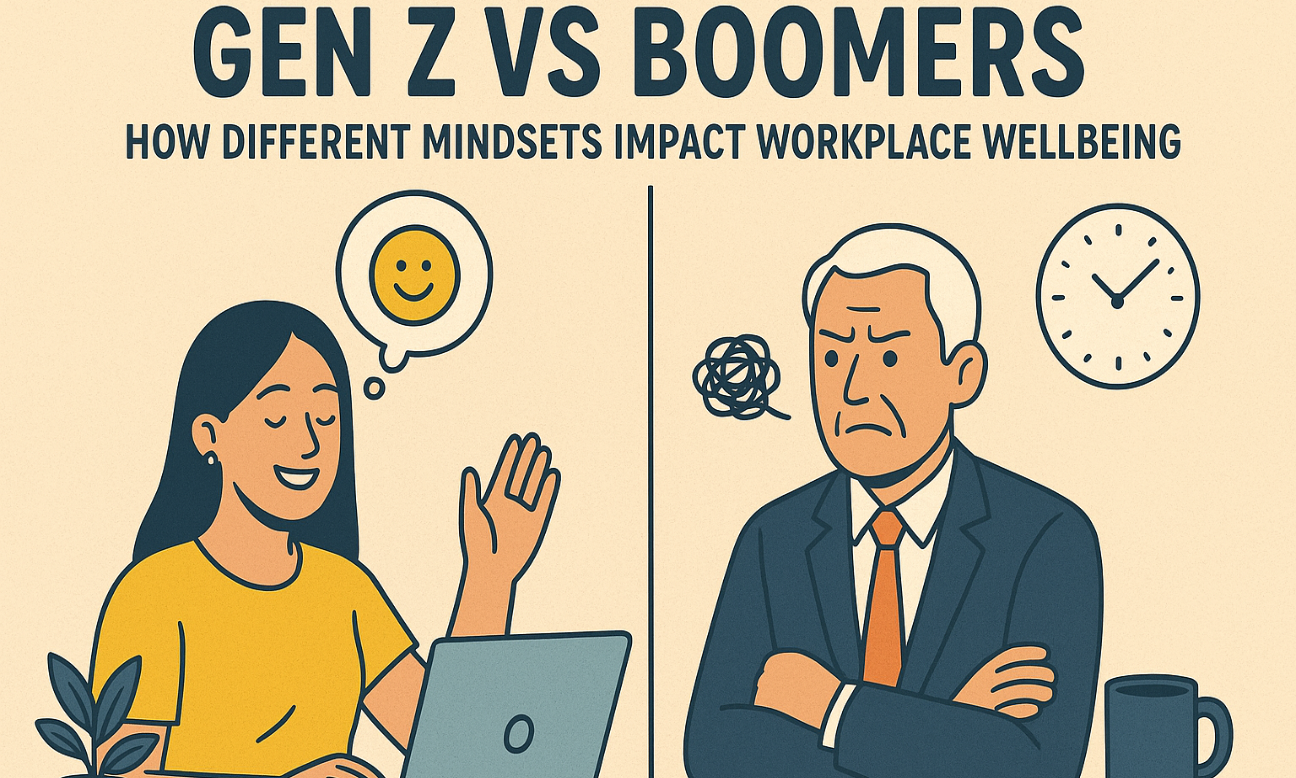
In today’s workforce, two generations stand at opposite ends of the professional spectrum: Baby Boomers, who built the modern workplace, and Gen Z, who are redefining it.
Both bring unique values, expectations, and attitudes toward work, and understanding these differences is vital for creating a culture of wellbeing, engagement, and productivity.
Born between 1946 and 1964, Baby Boomers grew up in an era that valued stability, discipline, and loyalty. Their careers were often defined by long-term commitment to a single employer, a clear hierarchy, and traditional office culture.
Workplace Wellbeing for Boomers Means:
Job security and stable benefits
Clear career progression and recognition
Face-to-face communication
Defined boundaries between work and home
Boomers often equate wellbeing with financial stability and respect for experience. However, this can clash with younger generations’ emphasis on flexibility and mental health.
Gen Z, born between 1997 and 2012, entered the workforce during rapid digital transformation and global uncertainty. They seek purpose-driven work, value mental health, and expect flexibility, not as a perk, but as a standard.
Workplace Wellbeing for Gen Z Means:
Flexible hours and remote options
Mental health support and open conversations
Diversity, inclusion, and authenticity
Meaningful work that aligns with personal values
Gen Z employees are more likely to leave a job that negatively affects their wellbeing, even if it pays well. For them, self-care equals career care.
The contrast between these two generations can cause tension:
Boomers may view Gen Z as less committed.
Gen Z may see Boomers as resistant to change.
However, both generations ultimately want to feel valued and supported, they just define that differently.
Bridging the gap means:
Encouraging intergenerational mentorship
Promoting hybrid work models that balance structure with flexibility
Offering wellbeing initiatives that support physical, mental, and financial health for all ages
A workplace that combines Boomers’ experience with Gen Z’s adaptability creates a culture that’s both stable and future-ready.
If you’re hiring or managing across generations, here are practical steps to take:
Build flexibility into structure: Allow autonomy while maintaining clear goals.
Prioritize communication: Offer multiple channels, face-to-face for Boomers, digital for Gen Z.
Invest in wellbeing programs: Include physical, mental, and financial wellness resources.
Promote mentorship and reverse mentorship: Let Boomers share wisdom and Gen Z share new ideas.
Recognize diverse motivations: Boomers value stability; Gen Z values meaning, cater to both.
As workplaces evolve, wellbeing will no longer be a benefit, it will be a business strategy.
Employers who understand generational differences and foster a culture of empathy will attract and retain top talent across all age groups.
The future of work isn’t about Gen Z vs Boomers, it’s about creating a workplace where every generation thrives.
In 2025 and beyond, successful organizations will blend the best of both worlds:
The resilience and commitment of Baby Boomers
The innovation and authenticity of Gen Z
When these values unite, workplaces become more balanced, inclusive, and sustainable for everyone.
